View Poll Results: Which suspension design?
- Voters
- 18. You may not vote on this poll
-
-
Hey Gary aka Sydneykid,
> We usualy use polyurethane bushes, they wear out a little quicker but don't flex as much as rubber, so they help retain the suspension geometery
What's your opinion on the different hardness poly bushes available?
I've used 'Energy Suspension' brand and felt they were too soft, with visible oval distortion.
Most other brands are similar in durometer hardness.
Prothane is significantly harder, but I've yet to try them.
Nick.
-
 Originally Posted by nd55

Hey Gary aka Sydneykid,
> We usualy use polyurethane bushes, they wear out a little quicker but don't flex as much as rubber, so they help retain the suspension geometery
What's your opinion on the different hardness poly bushes available?
I've used 'Energy Suspension' brand and felt they were too soft, with visible oval distortion.
Most other brands are similar in durometer hardness.
Prothane is significantly harder, but I've yet to try them.
Nick.
Hi Nick, polyurethane is not like rubber, its doesn't have air bubbles trapped inside to absorb the distortion. The excess material has to go somewhere, that’s the “bulging” as you call it. So it doesn’t matter what duro polyurethane you use, there will always be “bulging” required to absorb the initial distortion when the suspension member is bolted up.
What the different duro does is determine how much the bush moves under any given impact, say when the wheel hits a bump etc. That’s what’s important, not how much the bush “bulges” when you bolt it in.
Leaving aside the negative NVH effects of higher duro, if you go too high in the duro you can get tearing and the bush doesn’t last any time at all. If you go too soft in the duro then the bush will allow too much geometry change. Each bush is different in size and loading, so selecting the right duro is not a simple task.
Due to the low volumes involved, there usually isn’t much of a range of duro in the same bush part number. To further compound that R&D is expensive and the cheaper/smaller bush suppliers simply copy the larger bush manufacturers. A small number of high volume part numbers are available in multiple duros, Whiteline WRX anti lift kits being an example where there is a road duro at around 82 and a race duro at around 95.
Cheers
Gary
-
Originally Posted by Sydneykid
Sorry, I don't know what you mean by "traction bar"?
Cheers
Gary
Hey Gary, this is the traction Bar I'm refering to for our Honda's.
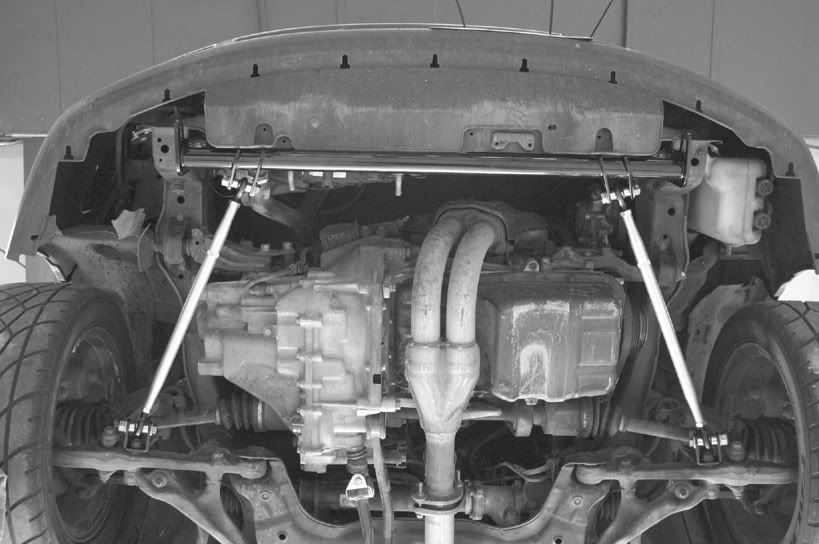

Now that you can see what I'm talking about, kindly answer my previous questions regarding.......
Thanks
Originally Posted by Bludger
in my DC2, which I believe has the same setup as the EG
How confidant and sound is the idea if I were to say add enough washers OR fabricate a set of spacers to fit in between the two piece front LCA.
What are (if any) the downfalls of this Idea???
I'm not sure if you're familiar with the many brands of traction bars available on the market. Is there any detriment to the movement of the front suspension if BOTH modifications were implemented?? (increased castor & traction Bar)
Would binding occur from the altered geometry? stress on the bushings? unwanted forces/stresses being applied to the LCA via both modifications?
Last edited by Bludger; 05-11-2009 at 10:02 AM.
-
Originally Posted by Sydneykid
I wrote an article for Hot 4's some years back on setting up EG suspension and the ability to enhance caster and camber was the catalyst. I also designed an EG caster kit for Whiteline at the same time. We ran an EG Si hatch at the Bathurst 12 Hour in 1993 for a 3rd in class, so I am rather familiar with that model.
Cheers
Gary
Wow this is abit of a trip to see someone like this on these forums.. i got that article in magazine, and have seen the whiteline parts but never knew if the caster kit was really worth it or if it was worth the money for the change
Is increasing caster a big thing in improving the cars handling? And how to whitelines camber kits go vs bigger honda companies like buddyclub and skunk2??
"Wheels are like bosoms to men, and cars have four of them"
-
Originally Posted by Bludger
Hey Gary, this is the traction Bar I'm refering to for our Honda's.
Now that you can see what I'm talking about, kindly answer my previous questions regarding.......
Thanks
Wow, that's one complex system of radius rods
I'm not really sure what it is that they are trying to achieve. Perhaps reduce the longitudinal (for and aft) compliance in the lower control arm inner and rear bushes. But the addtiional of radius rods would do nothing for the lateral and vertical compliance. It maybe of some use in a drag racing environment where the elimination of longitudinal movement would be of slight benefit, limiting caster change. But it would do nothing for maintaining camber or toe, so of very little use in road and/or circuit car.
Plus I'm not a big fan of spherical bearings in road cars, they are very exposed, have no dust covers or greasing points and they look somewhat undersized for my liking. My guess is they would need cleaning and greasing regularly and replacing frequently.
A much better solution would be to replace the bushes with polyurethane and fit a caster kit. That way you have the benefits of additional caster plus the full 360 degree improvement in rigidity from the polyurethane bushes (over the standard rubber).
Cheers
Gary
-
Originally Posted by Sydneykid
I'm not really sure what it is that they are trying to achieve. Perhaps reduce the longitudinal (for and aft) compliance in the lower control arm inner and rear bushes.
I think these arms are marketed at those with higher than usual power who are susceptible to wheel hop or torque steer.
Originally Posted by Sydneykid
But the addtiional of radius rods would do nothing for the lateral and vertical compliance. It maybe of some use in a drag racing environment where the elimination of longitudinal movement would be of slight benefit, limiting caster change. But it would do nothing for maintaining camber or toe, so of very little use in road and/or circuit car.
Maintaining longitudinal position helps maintain toe. Allowing the upright to move forward will pull the tie-rod forward, toeing out the wheel. The "traction bar" virtually eliminates this factor.
The new constraints on the suspension geometry will offer lateral compliance advantages in two ways:
1) An applied pure lateral force at the lower ball joint must partially pass through the radius rod linkage since the radius rods are not perpendicular to the control arm. The angle is quite small (20 degrees conservative approximation) so it's aid will be less than 10%.
2) The resultant force on the two-piece (effectively a rigid body) LCA can now never be purely lateral, it must always be perpendicular to the radius rod. Now you have the compliance bushing helping in a purely lateral force (which without the radius rod, could potentially load solely the inner LCA bushing).
The benefits above will be enhanced the closer the applied force is to parallel with the radius rod (engine power). The radius rods will have the least (zero) effect when the applied force is exactly perpendicular to the radius rod (i.e. the applied force is not at all constrained by the radius rod).
Without any data on the relative strengths of the compliance bushing and the inner LCA bushing, it's impossible to give any real numbers. Suffice to say, the effects on lateral compliance and therefore camber compliance, are an infinite times more than nothing.
-
[QUOTE]
Originally Posted by string
I think these arms are marketed at those with higher than usual power who are susceptible to wheel hop or torque steer.
Not sure how much "higher than usual is", for circuit racing we are looking at around 300 bhp and 220 ft lbs of torque running N/A on E85. That's around double the standard power output, but of course nowwhere near the 700 + bhp the drag guys are extracting forced induction and methanol.
All I can say is with bush upgrades and caster kits running R type tyres, we don't see any wheel hop or torque steer.
Maintaining longitudinal position helps maintain toe. Allowing the upright to move forward will pull the tie-rod forward, toeing out the wheel. The "traction bar" virtually eliminates this factor.
But it does nothing for the upper control arm. That's why we replace the rubber bushes in the upper control arm with polyurethane as well.
The new constraints on the suspension geometry will offer lateral compliance advantages in two ways:
1) An applied pure lateral force at the lower ball joint must partially pass through the radius rod linkage since the radius rods are not perpendicular to the control arm. The angle is quite small (20 degrees conservative approximation) so it's aid will be less than 10%.
It is also mounted inboard, at the shock mount.
2) The resultant force on the two-piece (effectively a rigid body) LCA can now never be purely lateral, it must always be perpendicular to the radius rod. Now you have the compliance bushing helping in a purely lateral force (which without the radius rod, could potentially load solely the inner LCA bushing).
There are 4 bushes involved, the lower control arm inner, the lower control arm rear and the 2 upper control arm bushes.
The benefits above will be enhanced the closer the applied force is to parallel with the radius rod (engine power).
Not quite as the driveshaft is mounted above the lower control arm. As is the steering arm.
The radius rods will have the least (zero) effect when the applied force is exactly perpendicular to the radius rod (i.e. the applied force is not at all constrained by the radius rod).
Exactly, that's why they are of zero use in controlling camber.
Without any data on the relative strengths of the compliance bushing and the inner LCA bushing, it's impossible to give any real numbers. Suffice to say, the effects on lateral compliance and therefore camber compliance, are an infinite times more than nothing.
You lost me. The aftermarket traction rod would allow horizontal and verticle rotation around its attachment point to the lower control arm. Any bush compliance, and there is a lot in the standard rubber bushes when new let alone after 15 years, would result in uncontrolled changes in caster, camber and toe.
My opinion, as stated above, is that the traction rod kit is pretty much wortheless unless you are drag racing and even then I would argue that there are better methods that would achieve a superior result.
So why are they made and sold? It's got more to do with the Japanese market than pure engineering. So it is worthwhile investigating the reason behind that market. Japanese workshops charge upwards of $500 per hour for mechanic’s time. That’s why Japanese aftermarket parts supplies sell 100% complete products, that come with every nut bolt screw and washer necessary, perfect thread, perfect holes etc. The workshop’s customer is not going to be very happy if he buys a $300 part that costs $1500 to fit because the mechanic spent a couple of hours searching for the right fasteners and drilling some holes. This huge disparity in the cost of parts versus the cost of labour means that solutions, to problems such as suspension geometry, have to be bolt on. Quick, easy, simple, in and out of the workshop. Plus they wouldn’t require a wheel alignment, bolt them on and drive out. All up maybe 30 minutes, say, $550 for parts and labour
The problem is this leads to unusual solutions to problems that would be better solved with other methods. Let’s take the upgraded bushes that we would typically apply in Australia where workshops labour rates are more like $80 an hour. The polyurethane bushes to fix this problem would cost less than $250 and take around 2.5 hours to fit. Add the necessary wheel alignment, you should never fit new bushes without one, and all up, say $500, parts and labour.
Technically there is no doubt the “Australian” solution is superior, but it would never happen in Japan, $250 in bushes plus $1500 in labour to fit them is just not going to be accepted by the workshop’s customer.
Personally I would take the opportunity to build in adjustment for caster and camber while I had the front suspension apart for fitting of the bushes. So I would spend and extra $100 to $150 on the bushes and get a far superior solution.
Cheers
Gary
-
The traction bars have nothing to do with Japan, they're of USA origin.
I'll reply more when I'm not at work.
-
Originally Posted by Sydneykid
But it does nothing for the upper control arm. That's why we replace the rubber bushes in the upper control arm with polyurethane as well.
My post is not to imply that the bars will eliminate the problem, rather that the effect is non-zero. Reducing the deflection at either end (top or bottom in this case) will help the problem.
Originally Posted by Sydneykid
It is also mounted inboard, at the shock mount.
I'm not sure what you are trying to say. The radius rod could mount halfway between where it is the photo and the inner LCA bushing. The physics remains the same, just that the angle will now be less and the radius rod will receive less load during an applied lateral force.
Originally Posted by Sydneykid
There are 4 bushes involved, the lower control arm inner, the lower control arm rear and the 2 upper control arm bushes.
As above ; reducing the "lower arm" compliance (movement of the lower ball joint) will result in less camber change, even if you leave the uppers the way they were. With a floppy LCA bushing, the upper control arm still sees the same force (once the lower bushing has fully compressed that is).
Originally Posted by Sydneykid
Not quite as the driveshaft is mounted above the lower control arm. As is the steering arm.
The steering arm and driveshaft have nothing to do with this. My statement was referring to how the radius rod will be loaded based on the direction of the tyre force. Still working in top/bottom view here.
Originally Posted by Sydneykid
Exactly, that's why they are of zero use in controlling camber.
... when the tyre force is in exactly the right direction. In all other directions, the radius rod will be doing something, and in one direction, the radius rod will take [almost] all of the lower arm work. Any time that the lower control arm bushings are taking less load with the radius rod attached, you have less camber compliance. Might not be much but it is not zero.
-
[QUOTE]
Originally Posted by string
My post is not to imply that the bars will eliminate the problem, rather that the effect is non-zero. Reducing the deflection at either end (top or bottom in this case) will help the problem.
I'm not sure what you are trying to say. The radius rod could mount halfway between where it is the photo and the inner LCA bushing. The physics remains the same, just that the angle will now be less and the radius rod will receive less load during an applied lateral force.
Where the radius rod attaches to the LCA effectively becomes a pivot point, the further away from the tye contact patch the greater the leverage exerted on the rubber LCA inner bush.
As above ; reducing the "lower arm" compliance (movement of the lower ball joint) will result in less camber change, even if you leave the uppers the way they were. With a floppy LCA bushing, the upper control arm still sees the same force (once the lower bushing has fully compressed that is).
But uncontrolled camber change is really only an issue when cornering, ie; side load is applied via the tyre to the upper and lower control arms. Where the additional radius rod does zero and the load is shared between the upper and lower control arm bushes. Hence why ungrading those bushes will actually have an effect on camber control whereas adding radius rods will have none.
The steering arm and driveshaft have nothing to do with this. My statement was referring to how the radius rod will be loaded based on the direction of the tyre force. Still working in top/bottom view here.
But torque steer is actioned through the drive shaft and the steering arm. So their location most certainly has something to do with any claim that adding radius rods will decrease torque steer.
... when the tyre force is in exactly the right direction. In all other directions, the radius rod will be doing something, and in one direction, the radius rod will take [almost] all of the lower arm work. Any time that the lower control arm bushings are taking less load with the radius rod attached, you have less camber compliance. Might not be much but it is not zero.
I would claim the reverse, the radius rod only works in 2 directions, longitudinaly. But even then, because of the leverage factor around the pivot point, the standard rubber bushes on the control arms are still the weakest point in camber control. Hence my ascertion that they should be changed as a first priority.
In summary, additonal radius rods are waste of time, money and effort unless you are in a drag racing environment with surplus power, lots of traction and you don't know how to change bushes.
Cheers
Gary
Last edited by Sydneykid; 17-11-2009 at 11:07 AM.
 Posting Permissions
- You may not post new threads
- You may not post replies
- You may not post attachments
- You may not edit your posts
-
Forum Rules
|


 Reply With Quote
Bookmarks