|
-
--------------------------------------
Stocky CL9 - 1:17.2
-
N14 Pulsar - VQ35 swap, Kelford C spec cams, 12.7:1CR, 6 speed HLSD, BC coilovers & 350Z 12.6" F brakes
Smashed VY SS Ute: Teins, AP Racing brakes, Billet wheels, lazy 481rwKw TT kit - PICS
-
very impressive i must say  but the low lobes arent connected to anything when the high cam is engaged. it is impossible unless each lob has its own valve, which it doesnt. If only u were here in melb id come past when the motor was apart... i wanna have a look @ the VVL setup just to be 100% that im correct but the low lobes arent connected to anything when the high cam is engaged. it is impossible unless each lob has its own valve, which it doesnt. If only u were here in melb id come past when the motor was apart... i wanna have a look @ the VVL setup just to be 100% that im correct 
-
 Originally Posted by silver_screen

very impressive i must say but the low lobes arent connected to anything when the high cam is engaged. it is impossible unless each lob has its own valve, which it doesnt. If only u were here in melb id come past when the motor was apart... i wanna have a look @ the VVL setup just to be 100% that im correct
It depends on the variable cam profile system. Most VTEC and VVL systems use 1 solenoid to lock up both sides of the rocker arm to the middle large lobe. In this case, you are right, the low lobes don't do anything when in high cam.
Not sure if Nissan came up with something similar, but Honda made a 3-stage VTEC system in the D series. Using 2 solenoids, the 1st would lock up one side of the rocker arm to the large lobe at the 1st RPM point, leaving the other valve to run on the small lobe. The 2nd solenoid's function was to lock that other arm to the large lobe once the 2nd RPM point was reached.
--------------------------------------
Stocky CL9 - 1:17.2
-
Originally Posted by silver_screen
very impressive i must say but the low lobes arent connected to anything when the high cam is engaged. it is impossible unless each lob has its own valve, which it doesnt. If only u were here in melb id come past when the motor was apart... i wanna have a look @ the VVL setup just to be 100% that im correct
No, the low lobes are not connected to the camshaft when the hi lobe is activated. The centre hi lobe is pushing down the centre rocker which is connected to the outer low lobe rockers, which are what push down the valves.
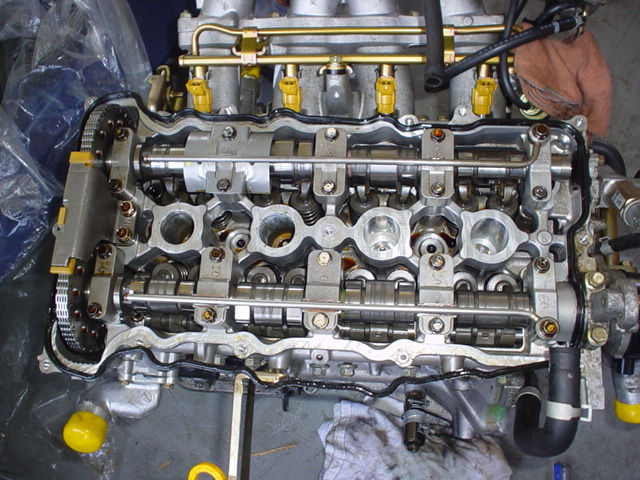
(Pic from sr20forum)
You can see the 3 rockers per cylinder under the exhaust camshaft. The two outer rockers push down the valves but when the 3 rockers are locked together, they follow the centre 'hi' lobe as it pushes the outer rockers down further than the outer 'low' lobes can.
Also notice the superior timing chain design to other SR20 motors. No start up rattle and no chain stretch!
N14 Pulsar - VQ35 swap, Kelford C spec cams, 12.7:1CR, 6 speed HLSD, BC coilovers & 350Z 12.6" F brakes
Smashed VY SS Ute: Teins, AP Racing brakes, Billet wheels, lazy 481rwKw TT kit - PICS
-
That picture shows me that the low lobes ride the hi lobe.. which means that once the hi lobe comes into the play.. the low lobes dont operate as per normal anymore.. meaning that the valve will now open higher and for longer because of the hi lobe.
What im sayin is that once the Hi lobe has engaged, the low lobes dont have anything more to do how high the valve will open and for long... They dont do anything for turbo spool times because its the hi lobe thats actually controlling the lift and duration of the valves... and as it seems its on both, intake and exhaust.. i must say, very stout head design. Only difference i can see with the chain design is that its thicker.. nothing else. everything else looks the same as my old 180 in the chain department 
Looks great!
-
Originally Posted by aaronng
It depends on the variable cam profile system. Most VTEC and VVL systems use 1 solenoid to lock up both sides of the rocker arm to the middle large lobe. In this case, you are right, the low lobes don't do anything when in high cam.
Not sure if Nissan came up with something similar, but Honda made a 3-stage VTEC system in the D series. Using 2 solenoids, the 1st would lock up one side of the rocker arm to the large lobe at the 1st RPM point, leaving the other valve to run on the small lobe. The 2nd solenoid's function was to lock that other arm to the large lobe once the 2nd RPM point was reached.
Ahhh i see, how very interesting. So you could pretty much control the lift and duration of either intake valve with these 3 stage vtecs... Both lo lobes r the same profile thou arent they?
The Nissan head doesnt seem to have the extra stages of valve control.. By the looks of the pic, they r either on or off. Only way to know for sure is to have the head right infront of me
-
-
Originally Posted by silver_screen
Ahhh i see, how very interesting. So you could pretty much control the lift and duration of either intake valve with these 3 stage vtecs... Both lo lobes r the same profile thou arent they?
The Nissan head doesnt seem to have the extra stages of valve control.. By the looks of the pic, they r either on or off. Only way to know for sure is to have the head right infront of me
The 3 stage Honda VTEC motor actually has the first stage where only one intake valve opens and both exhaust valves(basically a 12 valve motor) This promotes cylinder swirl and allows the engine to have 18:1 AFR's up until about 3000rpm. From here, the first solenoid engages and locks the two outer rockers together so that the previously closed valve follows the first stage lobe. The the 3rd stage from above 6000rpm follows the middle lobe.
N14 Pulsar - VQ35 swap, Kelford C spec cams, 12.7:1CR, 6 speed HLSD, BC coilovers & 350Z 12.6" F brakes
Smashed VY SS Ute: Teins, AP Racing brakes, Billet wheels, lazy 481rwKw TT kit - PICS
-
yer ive read about that tech.. In the D17 engine i think??
-
Originally Posted by silver_screen
That picture shows me that the low lobes ride the hi lobe.. which means that once the hi lobe comes into the play.. the low lobes dont operate as per normal anymore.. meaning that the valve will now open higher and for longer because of the hi lobe.
What im sayin is that once the Hi lobe has engaged, the low lobes dont have anything more to do how high the valve will open and for long... They dont do anything for turbo spool times because its the hi lobe thats actually controlling the lift and duration of the valves... and as it seems its on both, intake and exhaust.. i must say, very stout head design. Only difference i can see with the chain design is that its thicker.. nothing else. everything else looks the same as my old 180 in the chain department
Looks great!
The low lobe actually works from idle to about 4800rpm. Once oil flow locks the two outer rockers to follow the centre rocker, then the hi lobe controls both valves together. If they are not locked, then the two low lobes push the valves as per a normal 16 valve motor.
The low lobes(on my new custom camshafts) give much better low rpm exhaust gas flow and help get exhaust gas spinning the GT42R from around 3000rpm!
Note that the stock exhaust camshaft specs list lift/duration although this is not the case due to the lash pad design/shape.
The SR20VET timing chain is not actually thicker but it does use more rows(5) instead of the regular single row chain that all SR20DE/DET motors use due to the cam gear design.
N14 Pulsar - VQ35 swap, Kelford C spec cams, 12.7:1CR, 6 speed HLSD, BC coilovers & 350Z 12.6" F brakes
Smashed VY SS Ute: Teins, AP Racing brakes, Billet wheels, lazy 481rwKw TT kit - PICS
-
Originally Posted by silver_screen
yer ive read about that tech.. In the D17 engine i think??
First used in the EK Civic actually in a D15B motor
http://asia.vtec.net/article/d15b/
N14 Pulsar - VQ35 swap, Kelford C spec cams, 12.7:1CR, 6 speed HLSD, BC coilovers & 350Z 12.6" F brakes
Smashed VY SS Ute: Teins, AP Racing brakes, Billet wheels, lazy 481rwKw TT kit - PICS
 Posting Permissions
- You may not post new threads
- You may not post replies
- You may not post attachments
- You may not edit your posts
-
Forum Rules
|


Bookmarks